
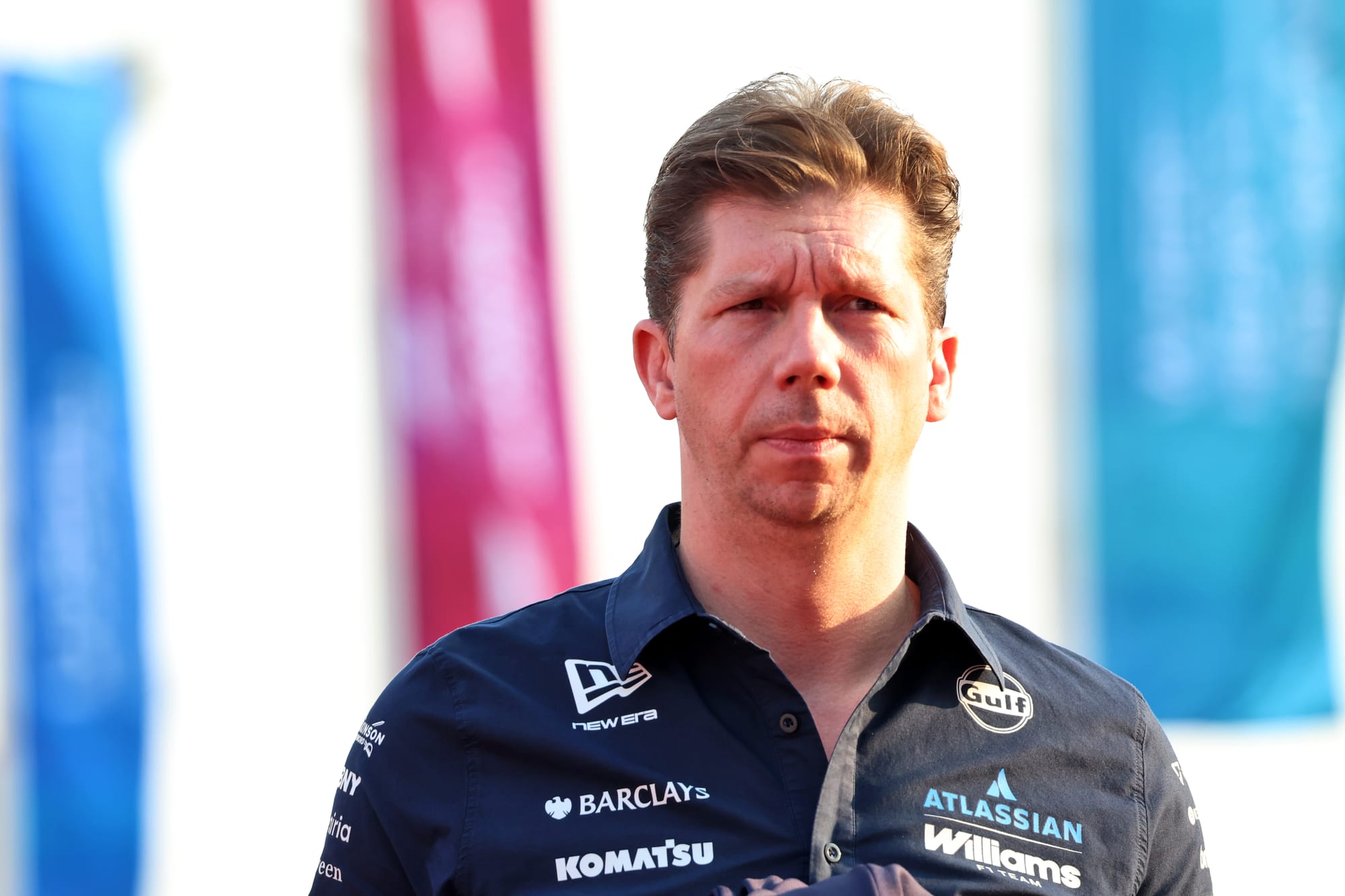
Williams has explained that overdue company restructuring triggered its Formula 1 cost cap penalty, as it made changes it thought were excluded from the cost cap.
The team was found to have breached the 2025 cost cap by £627,000 (0.48% of the total cap) and will have to pay the FIA a financial penalty - as well as lose 1.5% of its windtunnel and CFD testing time for the next 12 months.
Team boss James Vowles faced a number of questions on the breach during the Friday press conference in Qatar.
“The background to it is that the company structure of Williams was largely unchanged from 1977 and wasn't really fit for purpose in a modern world,” Vowles said.
“We went into it with every intention of being open, transparent with the FIA, which is what we held all the way throughout, but believed those costs, because it's company restructuring, [would] not be a cost cap expense.
“It was the company restructuring that put us over. We’ve had no financial benefit from it, no sporting benefit as a result of it, and you can see that the penalty is pretty much adjusted to be in line with that as well at the same time.
“But it was our interpretation of that, is that those costs are out of cap. The FIA’s interpretation of it are that they are in cap, and obviously we went with the FIA’s interpretation after much discussion.”
Vowles called it a “one-off company restructuring” because the previous structure “wasn't quite fit for purpose”.
Vowles encouraged “those interested” to look at Williams’s accounts on Companies House.
According to Companies House, during 2025 the team “transferred much of its trade and assets to a newly formed subsidiary, Williams Grand Prix Engineering Services LLP, an entity in which the company is a 99% member.
“This update to the corporate structure makes the organisation fit for the future, having been relatively unchanged in the nearly 50 years of operation since formation,
“The changes are about future-proofing our business, enabling smarter ways of working and positioning us to stay competitive at the highest level.
“The inclusion of a partner group will aid retention of certain staff and recognises the importance of those people to the delivery of the business plan.
“Member distributions have been declared to the 1% member of Williams Grand Prix Engineering Services LLP.”
Vowles described it as “Fundamentally, it's a single vertical structure as what was there previously.
“There's many downsides to fundamentally having that. You'll see there's a number of other companies have been created around it, which is just more efficient.
“The costs involved in it are fairly significant. If you think about what you have to do as a business, you probably have, in our case, close to 2,000 contracts with various suppliers and otherwise, that you have to migrate from one company to the next as a result of it. It's a very painful, lengthy task.
“There's some legal that goes with it. There's some compliance you have to do in UK law as a result of it as well at the same time.
“It was a process in the end that took, we initiated it probably around about six months, which probably gives you an idea as to how lengthy it is.
“But it was using finance and legal personnel for that period of which we had to bolster up to get us through that period.”
Williams fell down because it had a different interpretation of the regulations to the FIA.
“Clearly, we should have done something differently as a result of it,” Vowles admitted.
“Although the regulations aren't clear and black and white, it's interpretation, but the FIA is very clear on their perspective, which is the following: Because you've moved contracts from one business to the next, that effectively for them is procurement, which is an included activity.
“For us, we defined it as a financial and legal activity because it's literally taking a contract and changing a name on it.
“I can understand their interpretation, which is why we've accepted the breach, but I hope that helps you understand why it's subtleties, not clarity, really, in that circumstance.”
Not much of a penalty?
Vowles isn’t too worried about that 1.5% reduction in windtunnel and CFD testing time given that under the Aerodynamic Testing Restrictions system, there’s a sliding scale of windtunnel and CFD time in 5% increments.
“I think to put things in perspective, one position on the grid is 5% of ATR, and we've got a 1.5% delta. So it's less than a third of a position,” Vowles said.
“I'm rather hoping that we do a better job next year and put ourselves back up the grid, and that would be 15% something in that ballpark.
“So the reality is it's going to be small beans in the grand scheme of things.”
Williams is currently ninth out of 11 teams as of the last ATR period, and that’s unlikely to change for the start of 2027. That table will then reset after the first ATR period ends halfway through 2027 - when by Vowles’s 15% ballpark estimation, Williams will hope to be around sixth in the championship.